


Dental Fillings Guide - Tooth Surfaces

Updated: Apr 5
Cavities come in many shapes and sizes and the cost of a composite filling depends on the number of tooth surfaces affected. This Dental Fillings Guide will help our patients to understand how tooth surfaces are classified and how they influence the type and cost of treatment.
Each tooth has five distinct surfaces: the biting or chewing surface, the side facing the cheek, the side facing the tongue, the surface that contacts (or once contacted) the neighboring tooth in front, and the back surface of the tooth.
In private dentistry, fillings are charged based on the number of surfaces of the tooth that are affected, as this directly corresponds to the complexity, time, and amount of material required to repair the cavity.
What is a "Surface"?
A cavity is typically diagnosed based on which of the five surfaces of the tooth it affects: the biting surface (occlusal), the tongue side (lingual), the cheek side (buccal), or between the teeth (mesial/distal).
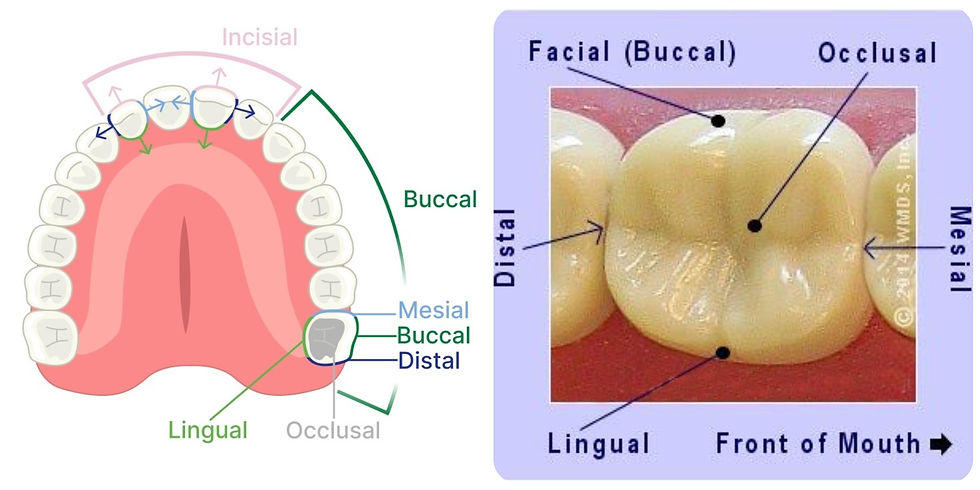
Tooth surface name definitions
Facial = the cheek or lip side (alternate name for back teeth: Buccal, alternate name for front teeth: Labial)
Lingual = the tongue side (alternate name for upper teeth: Palatal)
Incisal = the biting edge of an anterior tooth.
Occlusal = the chewing surface of a posterior tooth.
Mesial = the side of the tooth that faces the next tooth forward.
Distal = the side of the tooth that faces the next tooth toward the back.
Surface-Based Pricing Structure
1 Surface: A one-surface filling indicates that decay is limited to a single area of the tooth. This most often involves the chewing surface, where natural grooves, called fissures, can trap bacteria. Though it may also occur on the side facing the cheek or the tongue. Once the decay is removed from that one area, the filling is placed, shaped, and polished. Because only one surface requires treatment, the cost is lower than that of fillings involving multiple surfaces.

2 Surfaces: A two-surface filling means that decay has affected two areas of the same tooth. This commonly occurs when a cavity forms between neighboring teeth. In these cases, the decay cannot be accessed directly, so the dentist must go through the chewing surface to reach the area between the teeth, making it a minimum of two surfaces involved. After the tooth is fully numbed and the decay is removed, a matrix band is placed to help recreate the missing side of the tooth. This allows the filling material to form a proper contact without sticking to the adjacent tooth. Treating two surfaces requires additional time, materials, and precision, including extra work to shape and polish both areas. There is also greater risk involved, since an improper contact may require part of the filling to be adjusted or replaced.

3 Surfaces: A three-surface filling is required when decay affects three areas of a single tooth. This often happens when cavities develop between the tooth and both neighboring teeth, involving multiple contact points. Because more surfaces are being restored, additional time is needed to properly shape the tooth, recreate natural contacts, and carefully finish and polish each area. With the increased complexity, there are also more potential points where adjustments may be necessary to ensure proper fit and function. In some cases, a three-surface filling is needed when a tooth cusp cracks or when decay weakens the tooth structure to the point that part of the cusp must be removed and rebuilt. At this stage, the tooth may also be at higher risk for future fracture, and your dentist may discuss whether a crown could be a more durable long-term option.

4+ Surface Filling: A four-plus surface filling is needed when decay or damage affects four or all five surfaces of a tooth. This may occur due to extensive cavities, fractures, or when a large existing filling begins to leak at the edges. When leakage happens, decay can spread rapidly along the margin of the old restoration and may progress toward the nerve if not treated promptly. Four-plus surface fillings are also commonly required on front teeth when a chip or fracture involves the biting edge. Because so much of the tooth must be rebuilt, multiple surfaces need to be carefully shaped, contoured, and polished to restore proper function, appearance, and bite. This level of restoration requires significantly more time, skill, and materials, which is why it costs more than smaller fillings. In cases where nearly the entire tooth is involved, your dentist may also discuss whether a crown would provide better long-term protection. The image shown bellow illustrates a fracture affecting all five surfaces, which is still categorized as a four-plus surface filling.

Additional Information
When a cavity is close to the nerve, after drilling, washing and drying the tooth, a protective liner is placed at the base of the cavity to help minimize the risk of post-treatment sensitivity. While it isn’t possible to guarantee that a tooth will have no sensitivity after a filling, every step is taken to give the tooth the best possible chance of remaining comfortable. During the bonding process, the enamel is selectively etched first to ensure a strong enamel bond, and extra care is taken to allow the bonding agent sufficient time to penetrate the dentinal tubules. These techniques are used with the goal of improving long-term success of the restoration.


Comments